The Persian
The Persian is a shadowy, enigmatic presence in Gaston Leroux's The Phantom of the Opera, a man whom all Paris knows only as "the Persian" and who is well-known to every subscriber to the Opera. He is first introduced through the recollections of M. Faure, the examining magistrate in the Chagny case, who dismissed him as a visionary when the Persian came forward to declare that he had often met the ghost. Yet this same Persian, living in a little flat in the Rue de Rivoli, holds the key to the entire mystery: he alone knows Erik's true identity, his past, and the secrets of the Opera's underground realm. His narrative, which forms the core of the novel's later chapters, reveals him to be a former daroga—a chief of police—from Mazenderan, a man of noble heart and extraordinary knowledge, whose life has been intertwined with Erik's in ways that make him both Erik's savior and his reluctant keeper.
Identity and Background
The Persian's origins are revealed gradually, pieced together from his own account and the narrator's research. He was the daroga of Mazenderan, a high official in the Persian court, during the period Erik later called the "rosy hours of Mazenderan." It was the daroga who, on orders from the Shah, brought Erik to Persia, where Erik's will became law and where he committed horrors, including political assassinations and the construction of a palace so ingenious that the Shah could move unseen. When the Shah ordered Erik's death, the daroga saved Erik's life, providing him with the means to escape, and nearly paid with his own head for this act of mercy. A corpse, half-eaten by birds of prey, was found on the shore of the Caspian Sea and taken for Erik's body, allowing the daroga to escape with only the loss of imperial favor, confiscation of property, and perpetual banishment. He came to live in Paris on a modest pension, and it is there that he encounters Erik again, now installed as the Opera Ghost.
Role in the Opera and Relationship with Erik
The Persian is a constant, if unseen, presence at the Opera. He is known to be always in the building, and his appearance is marked by superstition: the ballet-girls ward off his "evil eye" by pointing their forefinger and little finger at him, and Gabriel, the chorus-master, is so frightened of him that he once jumped from his chair to touch iron, tearing his coat and injuring himself in a panic. Yet the Persian's true role is that of a guardian, watching over the Opera and its inhabitants, particularly Christine Daae. He hides in the lumber-room next to her dressing-room, listening to Erik's voice and observing the "curious moral traffic" between the monster and the young singer. He discovers the trick of the revolving mirror and the secret passages, and he understands Erik's nature better than anyone. His relationship with Erik is complex: he saved Erik's life, and Erik, in turn, has spared him, but the Persian lives in perpetual terror of Erik's "horrible fancies," knowing that Erik, "without the pale of humanity," feels no duty toward the human race. When Erik speaks of being "loved for himself," the Persian is alarmed, foreseeing fresh tragedies.
The Descent into the Cellars
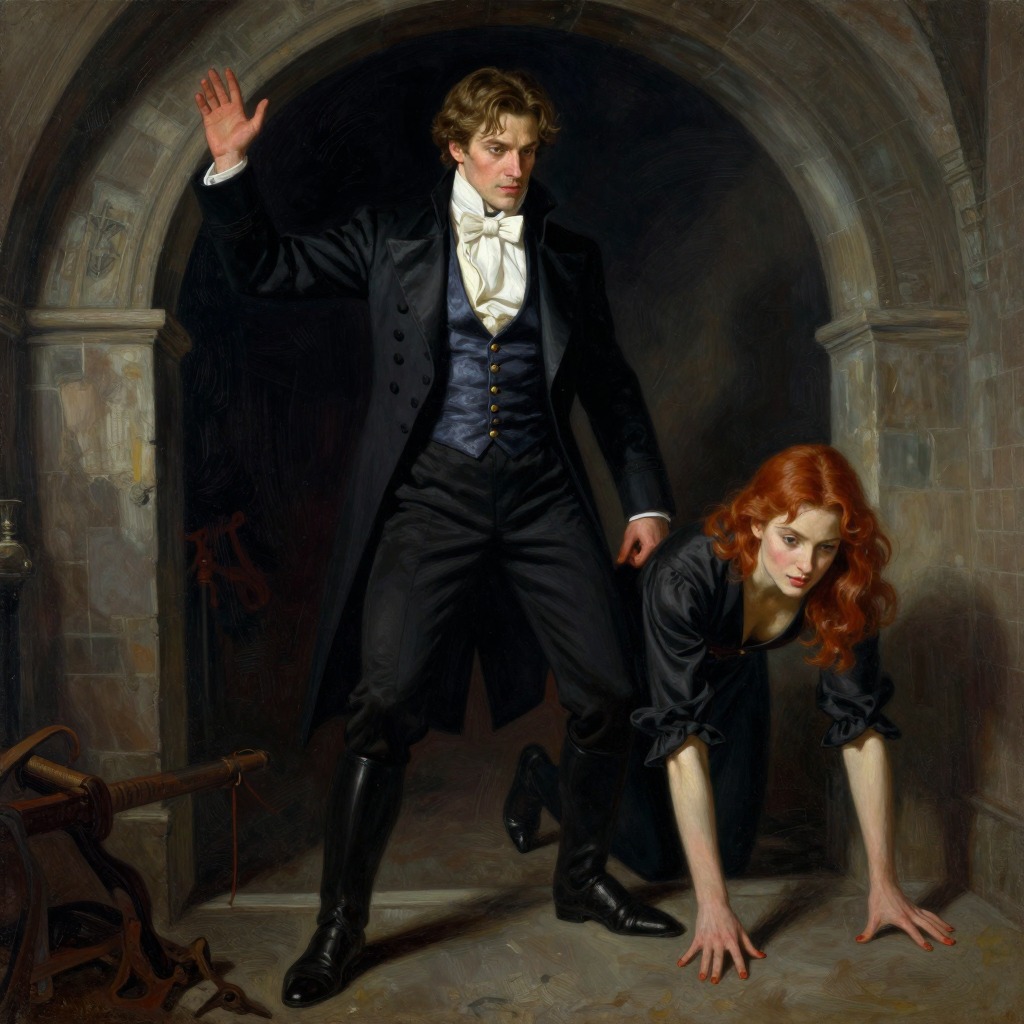
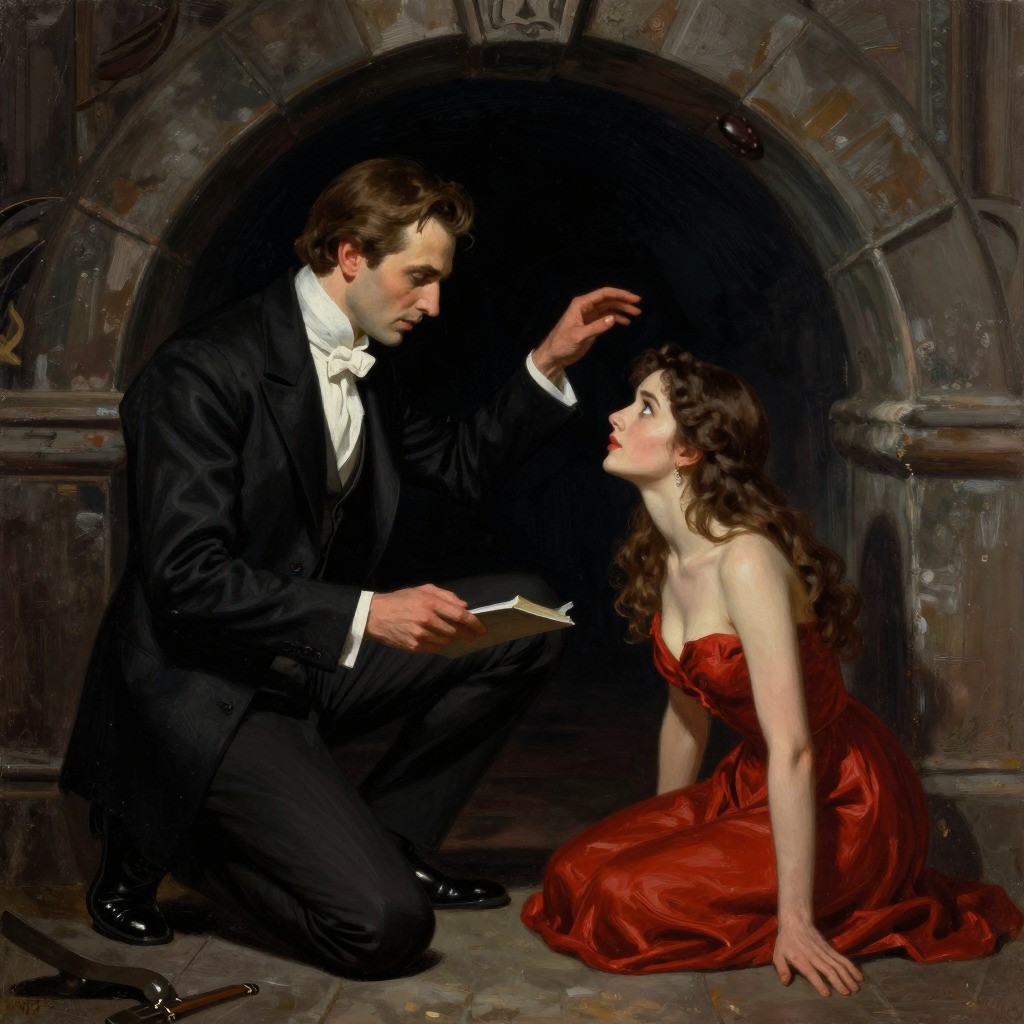
When Christine Daae is abducted onstage, the Persian is the only one who knows what has happened. He approaches Raoul de Chagny, who is rushing to pursue the commissary's false lead about Count Philippe, and stops him with the words, "Erik's secrets concern no one but himself." He then offers to take Raoul to Christine, arming him with a pistol from his servant Darius and leading him through the Opera's hidden passages. The Persian's knowledge is encyclopedic: he knows the secret entrance in the third cellar, the trap-door that leads to Erik's house, and the dangers that lurk below, including the rat-catcher with his head of fire and the siren who guards the lake. He instructs Raoul to keep his hand at the level of his eyes, a defense against the Punjab lasso, Erik's favorite method of strangulation. Their journey culminates in their dropping into the torture-chamber, a room of mirrors and illusions that Erik built, and where they endure the torments of the African forest, the desert, and the mirage, until the Persian discovers the black-headed nail that opens a trap-door to the cellar below, where they find barrels of gunpowder—Erik's plan to blow up the Opera if Christine refuses him.
The Ordeal and Rescue
The Persian's narrative of the torture-chamber ordeal is a testament to his courage and resourcefulness. He recognizes the room as an exact copy of the torture-chamber of Mazenderan, and he knows its tricks: the iron tree, the revolving mirrors, the electric heating. He tries to keep Raoul calm, explaining the optical illusions, but the heat and thirst drive them to the brink of madness. When they discover the gunpowder, they realize the stakes: Christine must turn the scorpion to flood the powder, or Erik will turn the grasshopper and blow them all up. The Persian's quick thinking—urging Christine not to touch the scorpion, fearing Erik's deception—saves them, as Christine's turning of the scorpion floods the cellar with water, and they are rescued by Erik himself, who, moved by Christine's tears and her promise to be his living wife, releases them. The Persian later learns that Erik, in a final act of renunciation, gave Christine a gold ring and allowed her to marry Raoul, and that Erik died of love, his skeleton later discovered in the Opera's substructure.
Aftermath and Significance
The Persian's role extends beyond the immediate rescue. After the tragedy, he is the keeper of the truth, holding the proofs of Erik's existence and Christine's papers. He tells the narrator the full story, and his manuscript becomes a central document in the novel. He also reveals Erik's past—his birth near Rouen, his life as a fairground "living corpse," his time in Persia and Constantinople, and his work as a contractor on the Opera's foundations. The Persian's final meeting with Erik, when Erik comes to his flat to announce his impending death, is one of the novel's most poignant scenes: Erik, trembling and weeping, tells of kissing Christine's forehead and feeling her tears, and the Persian, despite his horror, cannot help but pity him. The Persian's significance lies in his unique perspective: he is the only character who sees Erik as both a monster and a man, and his narrative provides the moral and historical depth that transforms the ghost story into a tragedy. He is the bridge between the supernatural and the real, the past and the present, and his quiet heroism—saving Erik's life, guiding Raoul, and preserving the truth—makes him an indispensable figure in the novel's architecture.